
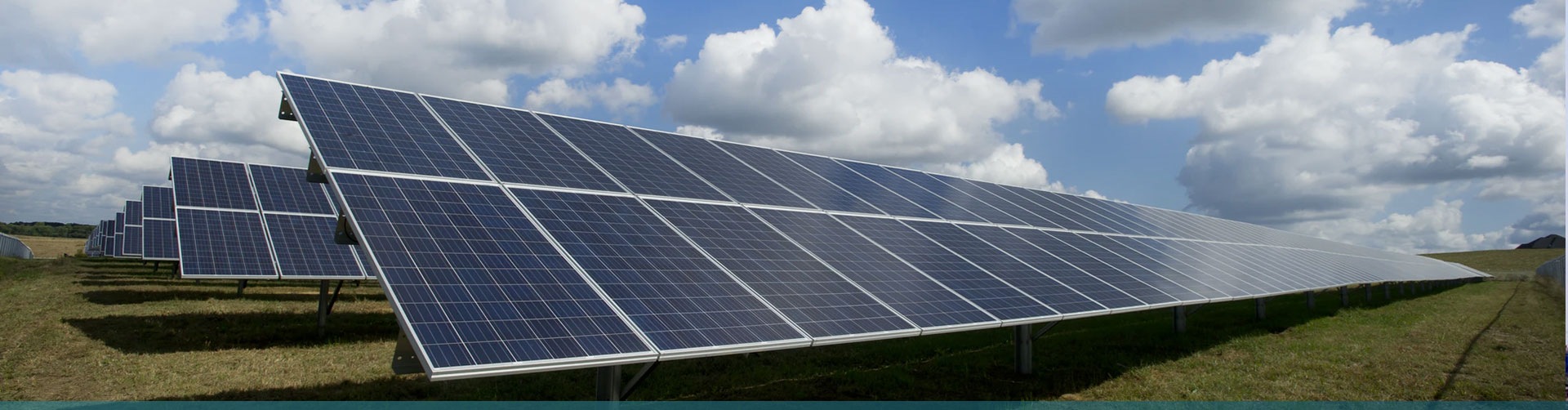
As global photovoltaic (PV) installed capacity continues to rise, power generation losses caused by dust, bird droppings, and sand accumulation on solar panels have become increasingly severe. According to the International Energy Agency’s (IEA) 2025 report, uncleaned PV modules suffer an average efficiency loss of 15–30%, reaching up to 40% in arid or industrial regions. This pain point has driven explosive growth in intelligent PV cleaning equipment worldwide, particularly in Europe, the Middle East, and Asia-Pacific markets, where automated cleaning robots are transitioning from “optional accessories” to “standard O&M tools.”

Market Dynamics: Europe & North America
In Q1 2026, SolarPower Europe released its Smart O&M White Paper, explicitly identifying “cleaning robot penetration rate” as a core metric for assessing plant intelligence. Large-scale ground-mounted plants in Germany, Spain, and Italy have widely deployed fully automated cleaning systems, with tracked robots featuring water-washing functions gaining over 60% year-on-year market share due to their adaptability to complex terrain and high cleaning standards. The U.S. market favors lightweight, modular designs suited for distributed rooftop applications, with some manufacturers offering detachable brush heads and solar-powered variants to reduce operational costs.
Extreme Environments: Middle East
In the Middle East, extreme heat and sandstorms demand exceptional durability and continuous operation from cleaning equipment. Saudi Arabia’s NEOM project has fully adopted robots with air-cooling systems and dust-sealed enclosures to ensure stable performance above 50°C. Dubai’s Mohammed bin Rashid Al Maktoum Solar Park integrates AI vision recognition, enabling robots to automatically identify pollution hotspots and prioritize cleaning, improving overall O&M efficiency by over 30%.
Asia-Pacific: The Supply Chain Hub
In Asia-Pacific, China — the world’s largest PV manufacturer and user — has developed a highly mature cleaning equipment supply chain. Domestic brands like Multifit, leveraging cost-effectiveness and customization, now dominate the local market while successfully expanding into Southeast Asia, Australia, and Latin America. Products such as the MR-XY series support multi-level assembly, stable traversal, and water-washing functions, making them ideal for large arrays; the MR-G1 model, offered via factory-direct sales, lowers procurement barriers and is especially popular among small-to-medium plants.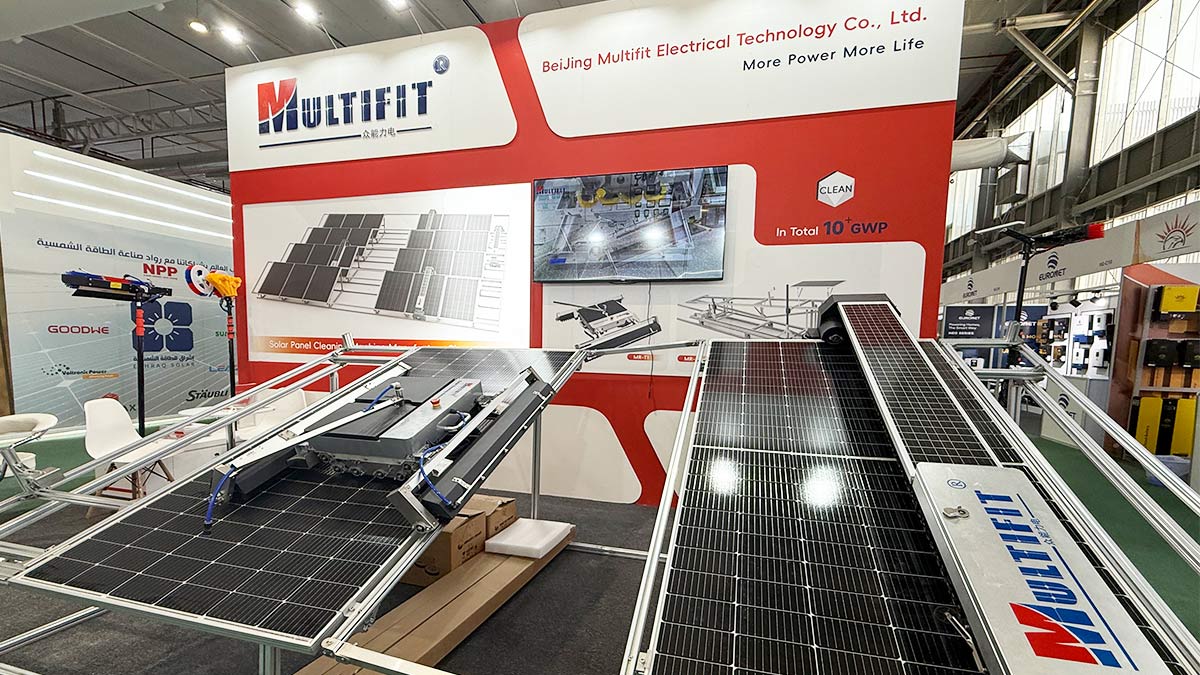
Technological Evolution 2026
Technologically, 2026 marks a shift toward “unmanned + data-driven” operations. Mainstream devices now integrate GPS positioning, remote monitoring, self-diagnosis, and cleaning log uploads. High-end models even interface with plant SCADA systems to enable closed-loop management: “pollution alert → automatic dispatch → performance evaluation.” Environmental trends are also driving innovation toward low-water-pressure, dry-cleaning, and recyclable-material designs to align with global carbon neutrality goals.
Future Outlook & ROI
Looking ahead, as PV LCOE continues to decline, the ROI period for cleaning equipment has shortened to 2–3 years, further accelerating adoption. The global PV cleaning robot market is projected to exceed $5 billion by 2027, with water-washing tracked models remaining dominant, while AI-driven intelligent scheduling systems will emerge as the next-generation competitive edge.
Post time: Jul-14-2026