
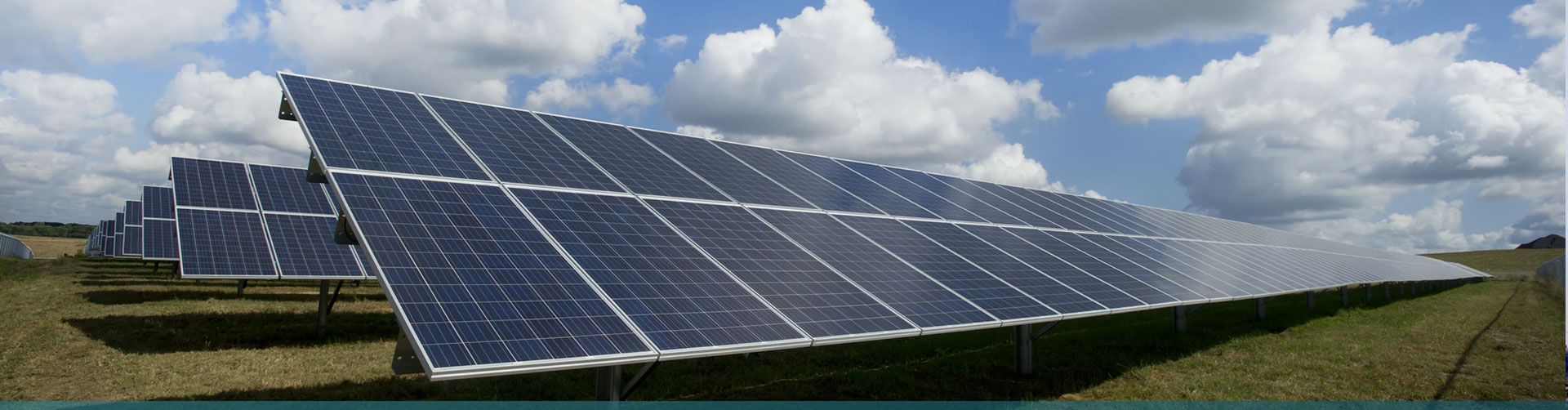
Against the backdrop of long-term global growth in PV installations and existing plants gradually entering normalized O&M cycles, module cleaning is transforming from an optional service into a rigid requirement for ensuring power generation. Since 2026, the automated cleaning robot sector has continued to heat up, with module manufacturers and equipment companies racing to stake their claims. Faced with the real-world challenges of complex terrain at mountainous plants and tracker plants, where manual cleaning is constrained, Beijing MULTIFIT recently launched the tracked PV panel cleaning robot MR-T2, featuring 22° climbing capability, 140mm gap crossing, and path planning, targeting medium-pollution cleaning scenarios at mountainous and gentle-slope tracker plants.
Industry Background: Growing PV Stock Makes Cleaning O&M a Rigid Demand
In its “Renewables 2026″ report, the International Energy Agency noted that solar PV remains the core driver of global renewable energy expansion and is expected to contribute more than three-quarters of global renewable capacity additions by 2031; utility-scale PV is projected to add approximately 2,075 GW from 2026 to 2031, with distributed PV adding another roughly 1,530 GW. Data from IEA SolarPower Europe shows that global new PV installations reached 664 GW in 2025, with global cumulative PV capacity surpassing 3 TW; although new installations may see short-term adjustments in 2026, the long-term growth outlook remains solid. SolarPower Europe
The other side of expanding installation scale is that massive numbers of existing plants are entering the O&M phase. Dust, sand, and grime on module surfaces block light and reduce transmittance, directly affecting power generation efficiency; insufficient or uneven cleaning leaves plants bearing hidden generation losses over the long term. As existing capacity grows year by year, module cleaning has shifted from a “periodic task” of the past to an O&M step requiring cyclical, standardized execution, and demand for cleaning equipment and services continues to expand accordingly.
Pain Points: Complex Terrain at Mountainous and Tracker Plants Makes Manual Cleaning Hard to Adapt
In terms of terrain and mounting structures, a growing number of newly built plants in recent years have adopted trackers and mountainous layouts. Reports from the National Energy Administration show that trackers can automatically adjust angle with the sun’s position, increasing power generation by about 10% compared with fixed mounts; but precisely because of tilt and undulation, such plants place higher demands on cleaning equipment in terms of climbing, obstacle crossing, and passability. National Energy Administration Manual wipe-by-wipe cleaning is limited in efficiency under narrow tracker spacing, steep slopes, or high-temperature, dusty environments, and also carries safety and management pressures from working at height. At desert, Gobi, and sandy PV bases in Xinjiang and elsewhere, some plants have switched to automated cleaning robots operating daily, whereas manual cleaning in the past often occurred only once every three to six months. CPC News
Meanwhile, the cleaning robot sector is drawing industry attention: in September 2026, Trina Solar’s TrinaTracker released the AURORA PV cleaning robot; Trina Solar in October, KP Group launched the waterless cleaning robot SR 2000 V3.0 for tracker and fixed plants at REI Expo 2026. ForPressRelease The successive entry of major players and new manufacturers confirms that automated cleaning is becoming one of the mainstream directions in PV O&M.
MR-T2 Takes the Stage: Built for Mountainous and Gentle-Slope Tracker Plants
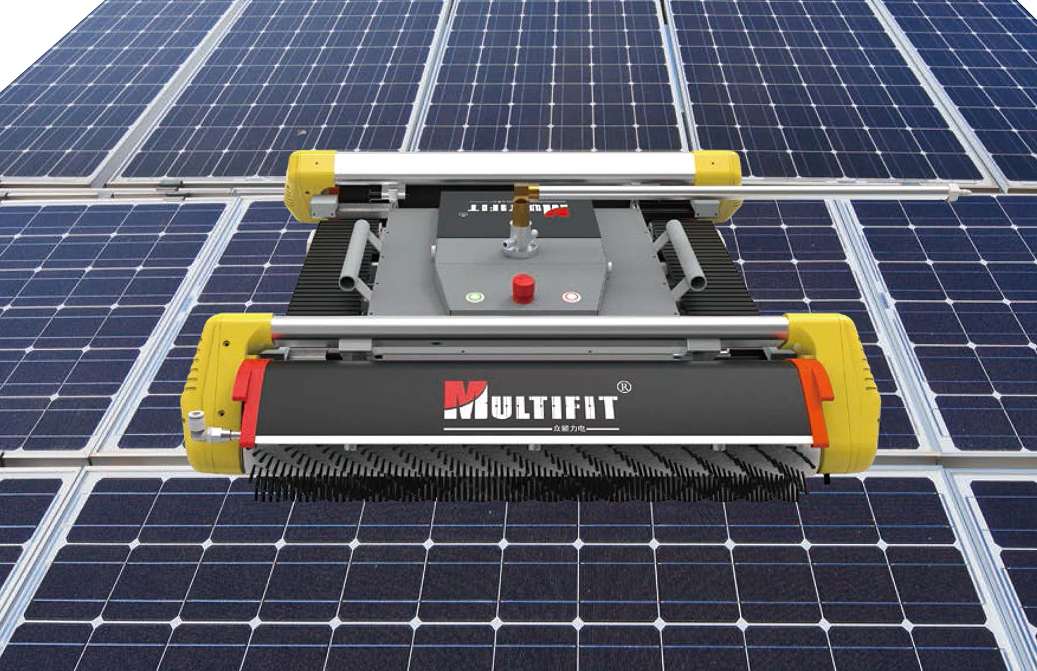
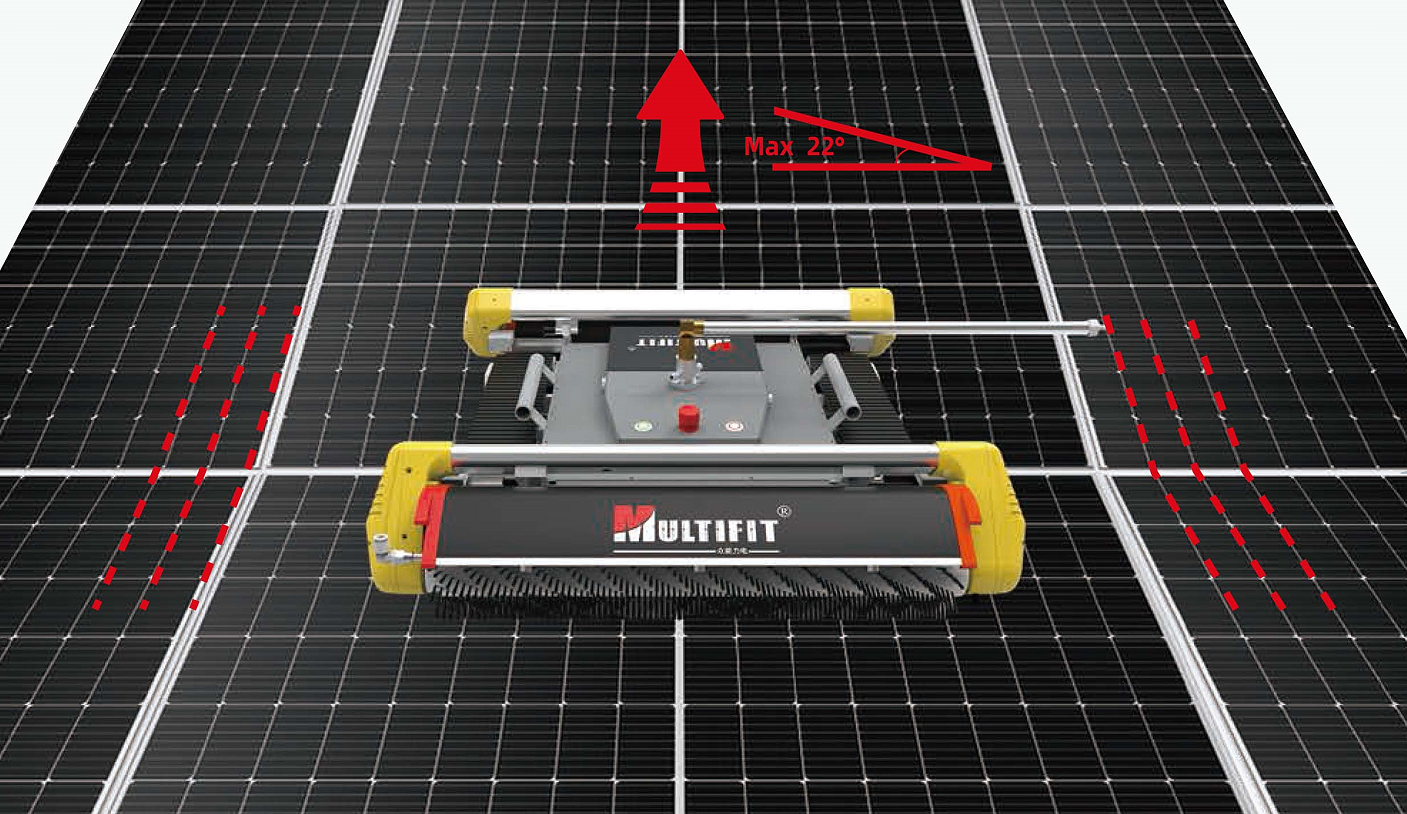
Against this trend, MULTIFIT’s MR-T2 is positioned for cleaning needs at mountainous plants and gentle-slope tracker plants facing medium pollution levels. According to product brochure specifications, the MR-T2 has a maximum climbing angle of 22°, a maximum obstacle crossing height of also 22°, and a gap-crossing capability of 140mm; the machine weighs 34.86 kg, achieving lightweight design while ensuring structural strength and cleaning width, making it easy to transport on site and mount/dismount from arrays. Compared with the base model T1 in the same series (15° climbing, 0° obstacle height), the T2 offers noticeably improved slope and obstacle-crossing capability, enabling operation on tilted trackers and mountainous surfaces.
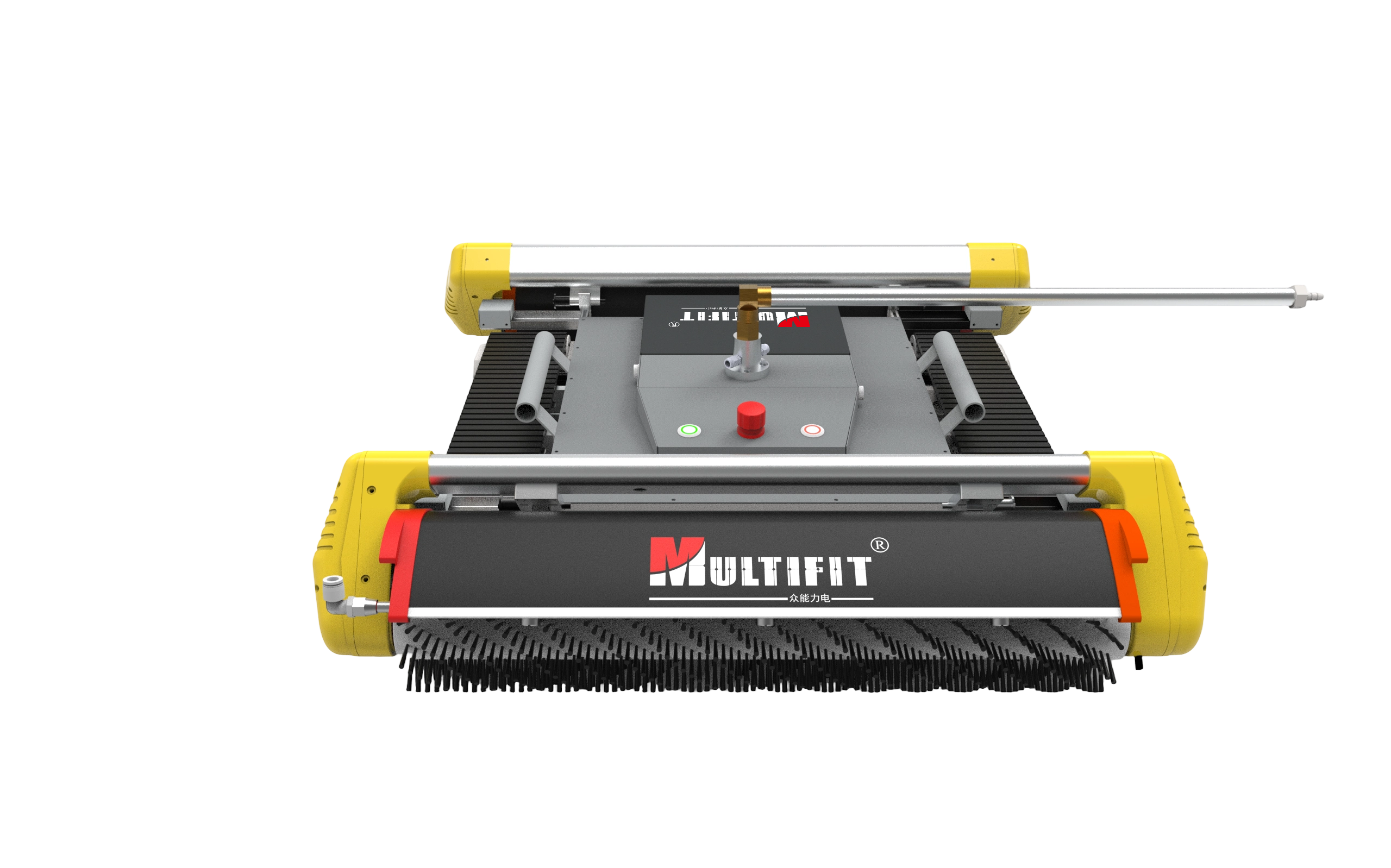
In appearance, the MR-T2 uses a black rubber track running mechanism with a large ground contact area for stable grip; the body is equipped with yellow anti-collision corner guards and red protective structures on both sides to cushion and protect against contact with module frames and mounts. The frame is a silver metal structure, with a battery compartment, red emergency stop button, and green status indicator light arranged on top; the cleaning section uses front and rear dual sets of roller brushes arranged transversely along the body, working with reciprocating travel to sweep the module surface, while a metal spray bar runs through the body for water line routing.
Functions and Diagnostics: Path Planning Plus Fault Code Display for Easier O&M
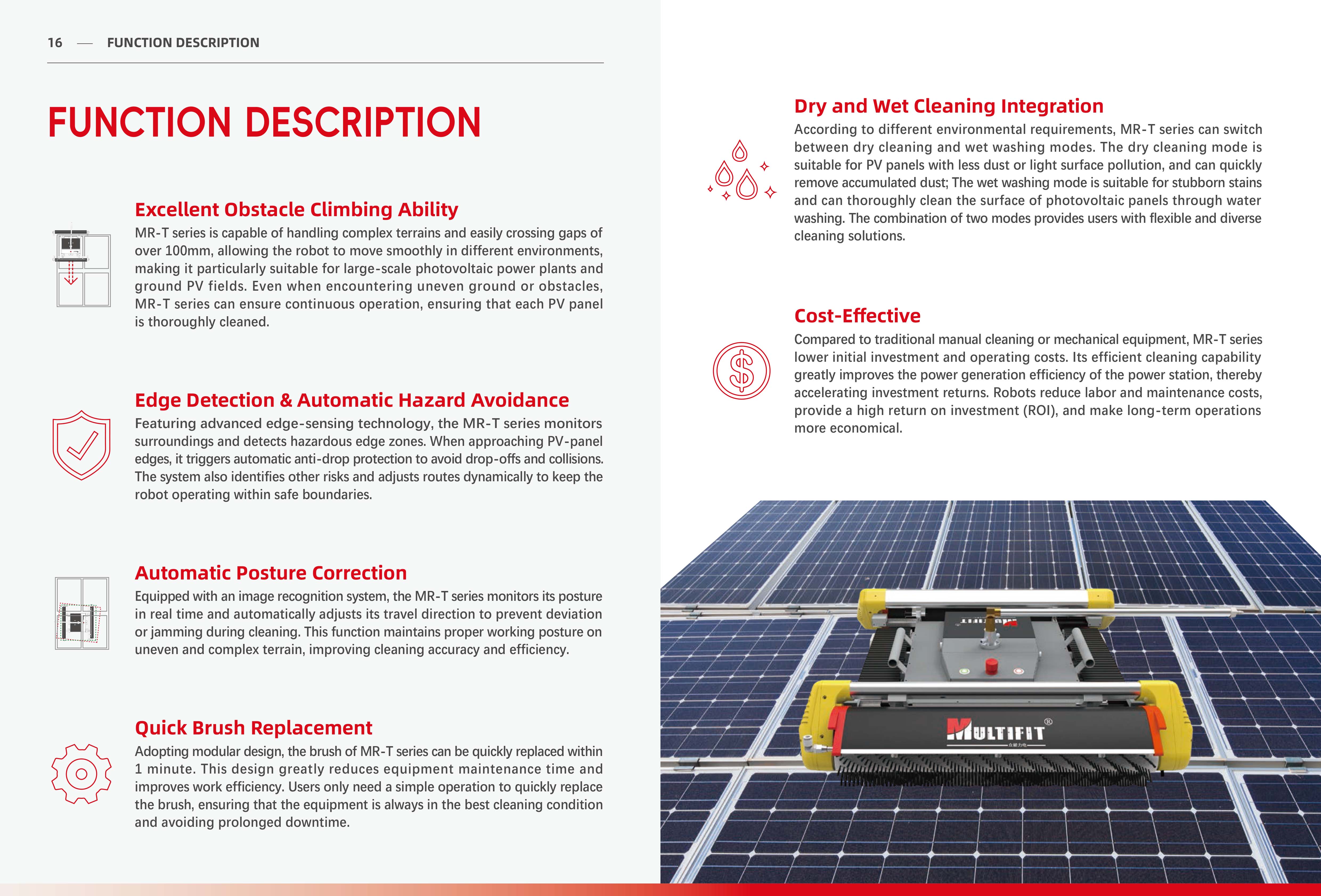
At the control level, the MR-T2 supports path planning as a firmware upgrade direction, allowing the robot to travel and clean along planned paths within the work area, reducing repeated manual control; the red and green button combination on the body panel can display machine fault codes, so O&M personnel can quickly locate problems based on fault codes when anomalies occur, shortening on-site troubleshooting time. It should be noted that the MR-T2 is a robust mainstream model focused on medium-pollution cleaning at mountainous and gentle-slope tracker plants; higher-end AI autonomous decision-making, RTK positioning, and map navigation are configurations of the series’ top model MR-T3, and customers can choose in tiers among T1, T1 (S), T2, and T3 according to terrain, pollution level, and automation needs.
For plant owners and O&M companies, the MR-T2 replaces manual labor with robots for batch cleaning, helping reduce long-term labor costs and ease safety management pressure under complex terrain; standardized mechanical cleaning also helps maintain consistent cleaning results and preserve module transmittance and generation levels. The lightweight body and fault code diagnostics lower the threshold for on-site use and maintenance, enabling small and medium-sized O&M teams to get up to speed quickly.
MULTIFIT has long focused on solar PV cleaning equipment, with products covering solar PV panel cleaning brushes and cleaning robots. Serving domestic and international plant owners, O&M companies, and channel distributors, its market covers the Middle East, Africa, South Asia, and other regions. The launch of the MR-T2 further improves the company’s positioning in the robot cleaning sector, enabling MULTIFIT to offer tiered selection solutions for different terrains and pollution conditions.
Post time: Nov-11-2026